
2025 US Job Growth Slowest in 30 Years; Only Health and State/Local Government Grew Faster than Their 10-Year Average
2025 is proving to be a “Year of the Jobs Crisis” for the US. Employment levels grew just 0.4%, the slowest growth rate in 30 years (outside of recessions). Federal job cuts shaved 0.1% from the growth rate, but growth is still significantly below 10-year and 20-year averages (1.1% and 0.8% respectively, using CAGR).
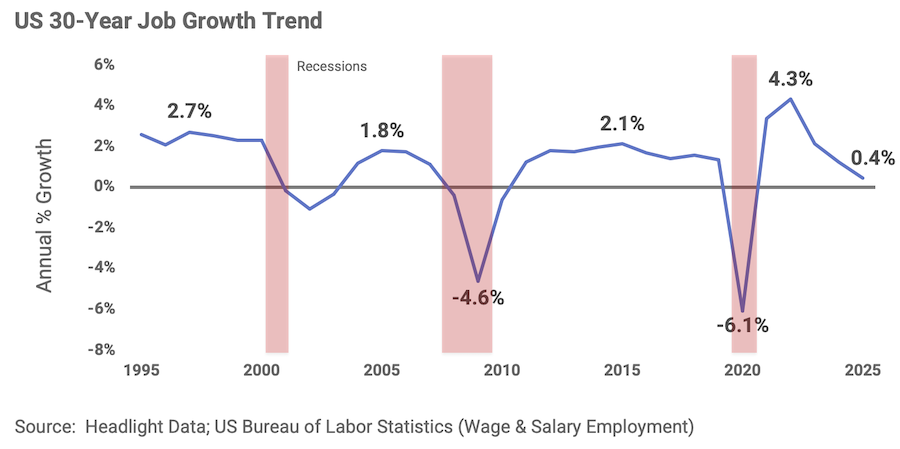
[Note: Data comes from the BLS’ Covered Employment Wage & Salary data series, which is based on quarterly payroll filings from all US businesses and is not a statistical survey like the monthly employment estimates that are published with a two-month lag. Data are subject to revisions up or down for three years.]
Simply put, the US economy isn’t built for, or ready for, a sustained slow-growth, high-inflation, high-interest-rate environment (read: stagflation). Is the US economy headed for recession? Unclear. The data center construction boom is coming just in time to compensate for the slowdown in the pandemic-fueled warehouse boom. Health care is still growing, though more slowly. Federal employment may rebound.
Still, as shown by the chart below, all industries except Health and State/Local Government are growing much slower than their 10-year average.
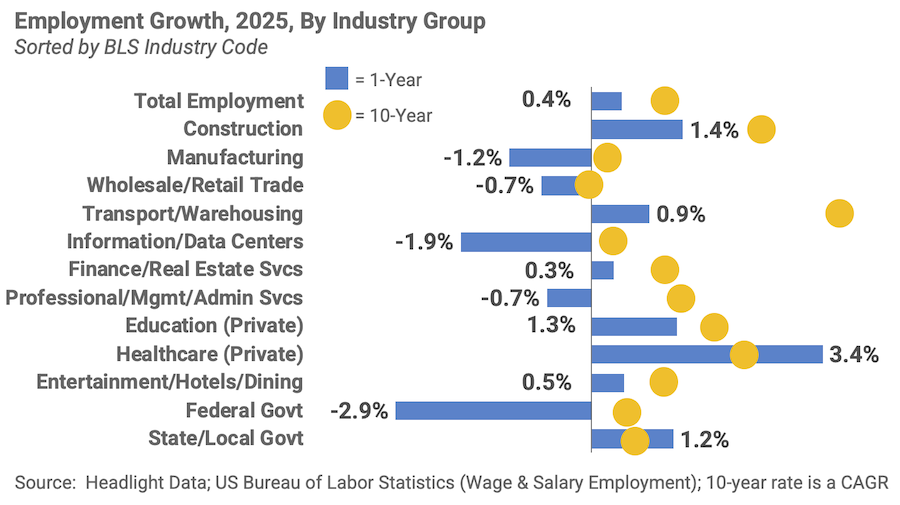
Down-side risks remain for job growth, particularly as AI use expands. High-growth, high-paying Financial and Professional jobs may decline, as might Higher Education jobs. Manufacturing automation will inevitably continue. The technology industry itself may be forced to reduce headcount as part of a competitive race among existing firms and to keep venture-funded startups (running on AI) from stealing market share.
As we’ve read in national media, numerous corporate CEOs believe strongly that AI will reshape the US workforce. What remains to be seen is the extent that AI helps boost productivity of some workers (and increases revenue and GDP) or reduces demand for headcount (when lowering fixed costs within a corporate structure).
We’ll continue to monitor jobs, AI use, and the impact on workers.